
Subscribe to Masich Internal Arts on YouTube and see video of Sam and his students around the world performing various parts of his syllabus.
About
Interesting Article in The Guardian re evidence of benefits of Taiji
Largest review of its kind confirms benefits of tai chi and other Chinese exercises
Analysis finds ‘high certainty evidence’ of their effectiveness for the 1.7bn people worldwide with musculoskeletal conditions
Traditional Chinese exercises such as tai chi can offer wide-ranging benefits for people with musculoskeletal disorders, improving physical function, pain, mental health, sleep quality and bone mineral density, according to the largest review of its kind.
More than 1.7bn people have musculoskeletal conditions worldwide. While prevalence varies by age and diagnosis, people of all ages in every country and every continent are affected.
Musculoskeletal conditions significantly limit mobility and dexterity, leading to early retirement from work, lower levels of wellbeing and reduced ability to participate in society. They are also the leading contributor to disability worldwide, with low back pain being the single leading cause of disability in 160 countries.
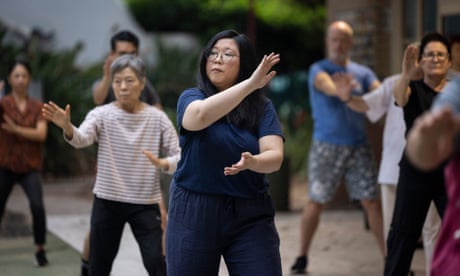
There was already evidence indicating traditional Chinese exercises were associated with beneficial health outcomes in people with musculoskeletal disorders, but much of it was fragmented and contained inconsistencies.
The overarching review of pooled data analyses of systematic reviews by researchers at hospitals and universities in China, published in the British Journal of Sports Medicine, drew on 92 data syntheses from 1,744 randomised controlled clinical trials.
It found “high certainty evidence” for the effectiveness of traditional Chinese exercise – such as tai chi, qigong, baduanjin, wuqinxi and yijinjing – for a range of health outcomes for people with musculoskeletal disorders.
These included improving movement in knee osteoarthritis, mental health associated with neck pain and knee osteoarthritis, and sleep quality associated with fibromyalgia.
Tai chi, in particular, significantly eased chronic musculoskeletal pain and stiffness in several conditions while increasing bone mineral density in participants with osteopenia or osteoporosis, the research found.
Maximum benefits were achieved when people did these exercises for longer than six months, at least three times a week, clocking up a total of at least 150 minutes a week.
“This comprehensive [umbrella review] provides a definitive, high-level evidence synthesis supporting [traditional Chinese exercises] as effective interventions for a range of musculoskeletal conditions],” the researchers concluded.
“The evidence, particularly for tai chi, reaches high certainty for improving key outcomes such as physical function in knee osteoarthritis, mental health in neck pain, sleep in fibromyalgia and bone density in osteoporosis.”
The findings suggested traditional Chinese exercises should be included in clinical guidelines and rehabilitation programmes worldwide, the researchers added.
“[These] exercises represent a safe, accessible, and cost-effective strategy that can complement conventional therapies, reduce pharmacological reliance, and empower patients in self-management.”
While the prevalence of musculoskeletal conditions increases with age, younger people are also affected, often during their peak income-earning years.
And with global population growth and ageing, the number of people living with musculoskeletal conditions and associated health problems is rapidly increasing.
“For healthcare systems and policymakers, promoting the adoption of traditional Chinese exercises, particularly in community and primary care settings, could be a strategic component of public health initiatives aimed at healthy ageing and chronic disease prevention,” the researchers said.
Something to ponder in these interesting times
Some thoughts from my master for coping………..
CLASS CALENDAR NOW UP TO DATE
The calendar for all classes has now been brought up to date to show my (un)availability up to the end of July 2022 as far as is currently known.
The calendar can be accessed via the link on the “Classes” page.
Understanding the Hips and the Waist by Master Sam Masich
Here is an article Sam published in Qi Journal in 2020. This is very relevant to all students but especially those in the Monday and Saturday classes.
A couple of contributions from my Master, Sam Masich, to while away some time in lockdown
Sam in a short discussion followed by him presenting a short qigong exercise for these strange times.
…..and a short (3 minutes-ish) interview with the family (in Spanish and German mainly) followed by some music with the following explanatory introduction:
This music presentation with Sam Masich and friends was requested by the Ex Convento de Culhuacán in México City as an online presentation for ‘Noche de Museos’ 2020. During the social-distancing period of the global Covid-19 pandemic, programs such as this one substitute for the normal annually-offered open-house Night-of-Museums format. Opening with an in-Spanish interview with ex-pat Méxican Yanira Jigetsu Masich, her husband Sam Masich, and son Karl T. H. Masich, the program features a short collection of performances by Sam playing music around the house solo, and with friends as they jam at a social distance.
Balance Loops for Lockdown
5 Section Sword Balance Loop
Sam has suggested a wee routine to practise balancing, which is always more difficult when you are using a weapon. Based on the 5 Section Sword Form (which you have all done!) it starts at Chase the Bird Up the Tree through to Dragon Stands at Cauldron’s Edge at which point, staying on the one leg, you go into Chase the Bird again and repeat as often as you wish.
Here is me having a go……….. 5 Section Sword Balance Loop
Yang 108 Balance Loop
A variation without weapon is from the Yang 108 Form but in a different sequence. It starts at Rising Kick, through Double Winds Pierce Ears and then into parting kicks, after which you return to Rising Kick and repeat.
Do feel free to kick higher than me – my back is restricting me just now!
37 Step balance Loop
For those who do not know the Yang 108 Form here is a simpler sequence from the 37 Step Form.
From Single Whip into Snake Creeps Down and through Golden Rooster you then turn and Kick with Heel and then go into Single Whip again and repeat as often as you like.See if you can spot the point at which I forgot how I had changed the sequence….
Class Update in view of COVID-19
Now that we are all social distancing I considered doing some online classes but with classes at different stages and half of them focusing on partner work I discarded this idea. There also may have been insurance issues with this.
However, much of the material we are working on is already available. If you go to the “Learning Aids” tab above on this site you will find drop down links to pages containing videos of the Yang 108 Form (handily split into sections), the 5 Section Solo Sword Form and the 8 Disc Methods Push Hands.
Those of you working on the Cheng Man-Ching 37 Step Form should have a DVD of this as you should of the Daoyin sets you have covered: Daoyin Shujin Zhuanggu Gong (the second one, Janice!) and some of you also should have Daoyin Baojian Gong and The Song of Daoyin Yangsheng Gong. If you do not have a DVD of any of these that we have done in class then let me know and I’ll get a copy to you.
Remember, these are not teaching videos, just a memory aid of me doing them in the garden or other members of the MIAM doing demonstrations of the relevant material.
If you search YouTube for Masich Internal Arts then you will find many videos of just about all of the MIAM curriculum. Some feature Sam and others his students and some cover the above topics. I am sure they will be of interest and very useful in helping you while away the hours, days and months to come! For those of you in the Monday class you will be able to check out some sensing sword and thirteen power sword stuff that we have started on.
Finally, if you have any questons, run into any problems or just have a brain fart then please feel free to ask me. We can use Skype, Facetime, Whatsapp or Messenger to sort things out by video link.
Meanwhle, take care, stay safe and I’ll see you again on the other side of this thing and remember…….
Take it slow ……….. (NORRIE!!!)
Christmas Holiday Dates 2019
Monday MIAM Class
Last class – 16th December
First 2020 Class – 13th January
Tuesday Class
Last class – 17th December
First 2020 Class – 14th January
Friday Class
Last class 13th December
First 2020 Class – 10th January
Saturday Tui Shou class
Last class 21st December
First 2020 Class 11th January
Indoor Student of Master Sam Masich
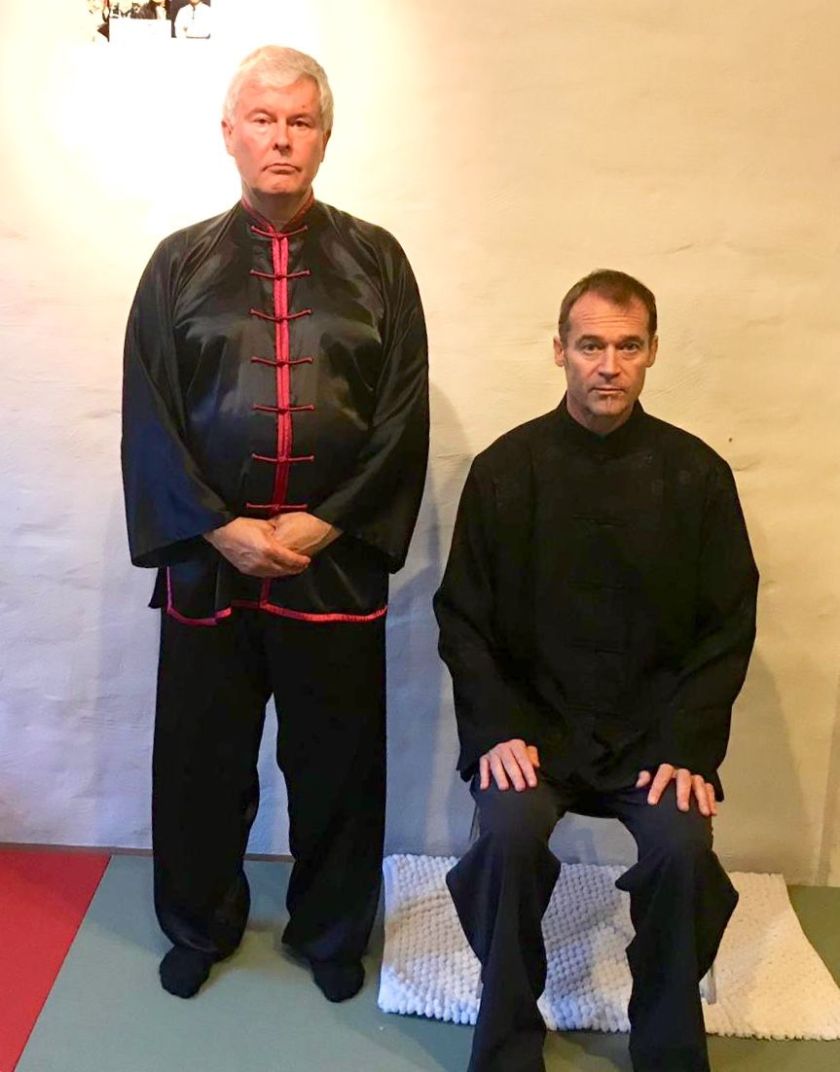
I am honoured that Master Sam Masich formally accepted me as an “Indoor Student” (Tudi) in a private Baishi Ceremony in his Berlin Studio on 18th August 2019. This was confirmed in a Public Ceremony in Brighton on 9th November 2019.
A few words on foot position
A quick breakdown of stance from Sam

